Why Lecture Hall Seating Is the Thing Tall Students Should Plan For
Quick Answer: Fixed lecture seating gives you no adjustment at all — the seat height, the desk height and the legroom are all set. For a tall student that usually means knees too high, a desk too low and a forward-hunched writing posture for hours a week. The fix is positional: aisle seats, back rows, and the row behind any step or gap, chosen deliberately in week one before seating habits set.
You can adjust your desk at home. You can adjust your chair in the library.
You cannot adjust a lecture theatre, and you will spend several hundred hours in one this year.
That makes where you sit a genuine ergonomic decision, not a social one.

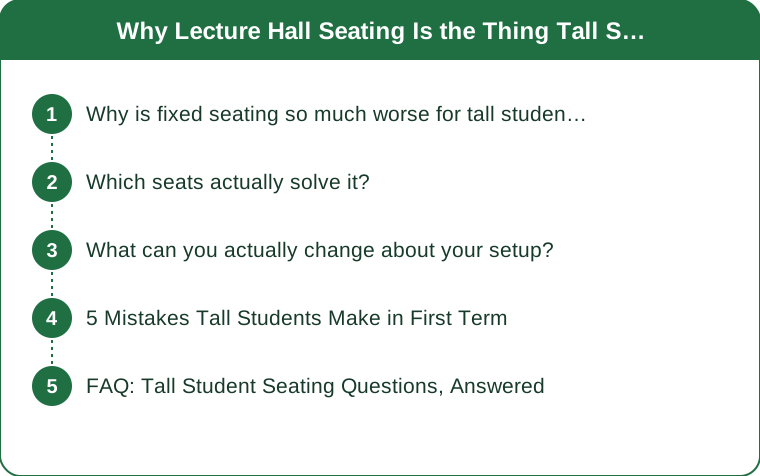
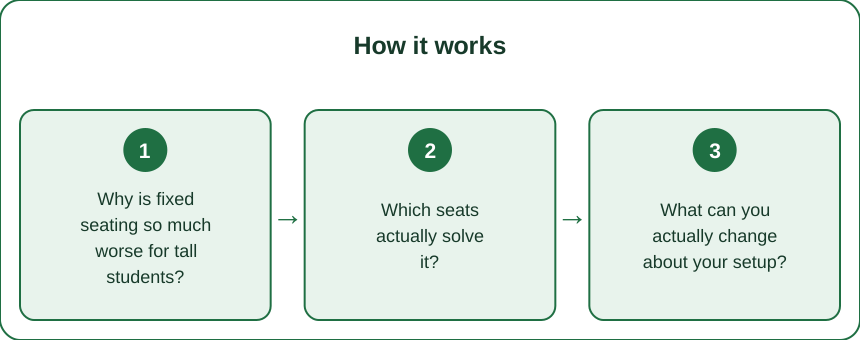
Why is fixed seating so much worse for tall students?
Because every dimension is set to a population average, and they compound.
Typical fixed lecture seating uses a seat height around 43 to 45cm and a writing surface at a fixed distance above it. That works reasonably for someone of average height. For a taller student, the seat is too low relative to leg length, so your knees sit above your hip line. That posture tilts your pelvis backwards, which rounds your lower back, which pushes your shoulders forward.
Then the writing surface — often a small fold-down tablet — is too low and too close, so you lean forward and down to use it. You now have a rounded lumbar spine and a flexed neck, held for fifty minutes at a time, several times a day.
And legroom is the third problem. Row spacing is designed for average femur length. If your knees touch the seat back in front, you will spend the lecture with your legs angled to one side, which introduces a rotation into the whole posture.
Which seats actually solve it?
Four categories, in rough order of usefulness.
Aisle seats. The single best option, because they let you extend one leg into the aisle. That alone fixes the femur-length problem and lets you shift position without disturbing anyone.
The back row. Back rows often have a wall behind rather than another row, which frequently means more space, and in many theatres the back row has a full desk rather than a fold-down tablet.
The row directly behind a step, gap or walkway. Any break in the seating rhythm usually comes with extra depth. These seats are unremarkable to most students and quietly excellent if you are tall.
Front row where there is a table. In many theatres the front row faces open floor with a proper desk, which solves the writing-surface height problem entirely.
What to avoid: the middle of a middle row, which is the worst combination of no legroom, no exit and a fold-down tablet.

What can you actually change about your setup?
A small number of portable things make a disproportionate difference.
Raise the work, do not lower yourself. A laptop stand, or simply a thick folder or two books under your laptop or notebook, lifts the writing surface several centimetres and removes a large part of the neck flexion. This is the highest-return item in the bag.
Use a slightly larger bag as a footrest. Placing your bag under your feet raises your knees further, which is wrong. Placing it slightly forward so you can rest your heels on it and extend your legs is right. The goal is more hip angle, not less.
Write on a slope. A ring binder placed under your notepad creates an angled surface, which cuts the amount you need to bend your neck. It is the oldest ergonomic trick there is and it still works.
Move every twenty minutes. No posture is good for fifty minutes. Changing which leg is extended, sitting back for a while, and standing at the break all matter more than achieving a perfect position.
5 Mistakes Tall Students Make in First Term
1. Sitting wherever your friends sit, permanently. Sit together in the first week by all means, then move to the aisle of the same row. Nobody minds and you get an entire year of legroom.
2. Carrying the whole term in one bag. Heavy asymmetric loads are worse for a long spine, because the lever arm is longer. Use both straps, and leave what you can in a locker.
3. Assuming the dorm desk will be fine. Standard dorm desks are commonly 72 to 75cm high, which is low for a tall student. A monitor riser or a stack of books plus an external keyboard costs very little and fixes most of it.
4. Waiting until something hurts. Postural discomfort in fixed seating accumulates over weeks. The adjustments cost nothing, so make them before you need them.
5. Not asking about accessible seating. If you are genuinely uncomfortable in standard seating, universities can and do reserve seats. It is a routine request and considerably less awkward than the alternative.
FAQ: Tall Student Seating Questions, Answered
Is it worth arriving early just to get a good seat?
For your two or three longest weekly lectures, yes. Ten minutes earlier for a fifty-minute lecture, twice a week, is a good trade. For a short seminar it matters much less.
What about lab stools and studio seating?
Often worse than lecture seating, because stools have no back support at all. If the stool is adjustable, set it so your hips sit slightly above your knees. If not, ask whether a different stool is available — most departments have a range.
Does any of this actually cause back pain?
Sustained flexed postures are associated with discomfort, though pain is multifactorial and varies between people. This is general information, not medical advice — persistent back pain is worth discussing with a qualified professional rather than solving with seat choice alone.
TL;DR:
- Lecture seating is fixed at an average and gives tall students knees-high, desk-low, neck-forward posture by default.
- Aisle seats, back rows and rows behind a step solve most of it, and cost nothing.
- Raise the writing surface with a laptop stand or a folder, and use your bag to extend rather than raise your legs.
- Choose your seat deliberately in week one, before habits and social geography lock in.
Everyone else can sit anywhere. You get to be slightly more strategic about it, which is a small price for a considerably more comfortable year.
Keep Reading
This article is for general informational and styling purposes only. Fit, sizing, and product availability may vary.