The Tall Student's Guide to a Dorm Room That Doesn't Fight You
Quick Answer: Standard dorm furniture uses fixed dimensions built around average heights — 75-inch beds, 29-inch desks, 18-inch chairs, and shower heads at about 6 feet. For anyone over roughly 5’10”, every one of those is wrong, and each has a cheap fix: bed extenders or a mattress topper positioned lengthwise, desk risers, a seat cushion or footrest to correct chair height, and a shower head extension arm.
You’ve been sleeping diagonally for a month and hunching at a desk that hits your thighs. None of it requires permission from housing, and none of it costs much.

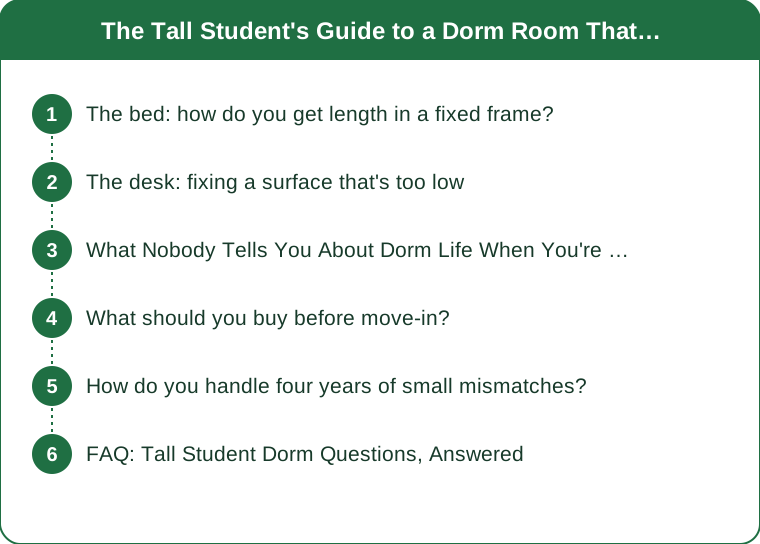
The bed: how do you get length in a fixed frame?
Standard dorm beds are twin XL, at 80 inches — which is genuinely long, and it’s the one piece of dorm furniture that usually works.
Check first, though. Some older dorms have standard twins at 75 inches, which is short for anyone over about 6 feet. This is worth confirming before move-in, since it changes what you buy.
If it’s a standard twin and too short:
- Bed extenders — frames that attach to the foot and extend the sleeping surface. Around $30 to $60, and they work with most metal dorm frames.
- A mattress topper positioned to overhang the foot end by a few inches, with a stool or a stack of books supporting the overhang. Inelegant and effective.
- Request a longer bed from housing. Many universities have XL frames available on request and simply don’t advertise it. This is the free option and the first thing to try.
Lofting or raising the bed creates storage space underneath, which matters more in a small room. Most dorm frames are height-adjustable — if yours has pin holes, it adjusts, and facilities will usually change it if you ask.
Also worth knowing: if the mattress is thin and the frame has a hard edge at the foot, a rolled towel at that edge prevents the pressure point that causes ankle discomfort when you overhang slightly.
The desk: fixing a surface that’s too low
Standard desk height is around 29 to 30 inches, which suits a seated person of roughly average height. For anyone over 5’10”, it forces either hunched shoulders or splayed legs.
The reliable fix is desk risers — furniture risers under the legs, or a purpose-made desk riser platform on top.
Furniture risers ($15 to $25 for a set of four) lift the whole desk by 3 to 5 inches. This is the better solution because it preserves the desk’s usable surface and keeps monitors at a natural relationship to the keyboard. Check that they’re stable and rated for the weight.
Desk-top risers or laptop stands raise the screen but not the writing surface, which solves half the problem. Good in combination with an external keyboard on the original surface.
The correct target: elbows at roughly 90 degrees with shoulders relaxed when your hands are on the keyboard. Measure from the floor to your elbow while seated properly — that’s your desk height.
The chair matters as much. Standard dorm chairs are around 18 inches, which is low for long femurs, forcing knees above hips and putting the load on your lower back. A firm seat cushion of 2 to 3 inches is the cheapest correction and it’s genuinely effective.
Then a footrest if raising the chair lifts your feet off the floor. A stack of textbooks works.
What Nobody Tells You About Dorm Life When You’re Tall
The shower head is the daily annoyance nobody warns you about. Standard mounting is around 72 inches. A shower head extension arm ($15 to $25) adds 8 to 12 inches, installs without tools in most cases, and is removable at move-out. This is the single highest-satisfaction purchase on this list.
Bunk beds have specific length problems beyond the mattress — the guard rail and the frame end often sit inside the mattress length. If you’re assigned a top bunk, this is worth raising with housing.
Communal furniture in lounges is worse than dorm furniture, and there’s not much to do about it except choose where you study. Library chairs vary widely; find the ones that fit and use them.
Doorways and low fixtures. Older buildings have lower door frames and hanging light fixtures than modern code requires. Worth noticing rather than discovering.
Laundry machines and low sinks cause back strain over four years. Bending at the hips rather than rounding the back, and using a small stool for laundry loading, both help more than they sound like they would.
Roommate negotiation is easier than expected. Most people are entirely willing to take the bed that’s slightly better positioned or trade desk placement if you explain why. It’s a two-minute conversation that saves months of discomfort.

What should you buy before move-in?
A prioritized list, roughly $100 total.
Essential:
- Shower head extension arm — $15 to $25. Highest daily impact.
- Furniture risers for the desk — $15 to $25.
- Firm seat cushion, 2 to 3 inches — $20 to $35.
Confirm first, then buy if needed:
- Twin XL sheets — check which size your dorm uses before buying. Buying the wrong ones is the single most common move-in mistake for tall students.
- Bed extender — only if the frame is a standard twin.
Worth adding:
- A footrest or small stool — doubles as extra seating and as laundry-loading support.
- An adjustable laptop stand — $25 to $40, and it travels to the library.
Ask housing about, don’t buy:
- Longer bed frame
- Bed height adjustment
- Desk or chair swap from surplus
Many universities have accommodation processes for height-related needs, and a surprising number of students never ask. The worst outcome is a no.
How do you handle four years of small mismatches?
The cumulative effect is real, and a few habits offset it.
Vary your study positions. No chair fits perfectly, so rotating between the desk, a standing setup, and a library chair distributes the strain rather than concentrating it.
Build a standing option. A tall dresser or a windowsill at the right height, with a laptop stand, gives you a second position for free. Standing height should put elbows at 90 degrees, same rule as sitting.
Take the walking route. Long-limbed people accumulate stiffness from prolonged sitting faster in fixed-height furniture. Movement between classes matters more, not less.
Watch for the specific complaints: neck and upper back from low screens, lower back from low chairs, and hip tightness from prolonged sitting with knees above hips. Each maps to a specific fix above.
And a general principle: the dorm room is temporary but four years of it isn’t. Spending $100 in the first week to correct the geometry is one of the better returns available in a student budget, and it’s less than a semester’s coffee.
This is general information, not medical advice. Persistent back, neck, or joint pain is worth having looked at by student health services, which are free at most universities and consistently underused.
FAQ: Tall Student Dorm Questions, Answered
Can I request accommodations for height?
Many universities will accommodate reasonable requests — longer bed frames, different furniture from surplus, or room assignment considerations. It’s usually handled through housing rather than disability services. Ask early, before assignments are finalized.
Are dorm beds twin or twin XL?
Most modern dorms use twin XL at 80 inches, but it varies and older buildings often don’t. Confirm with housing before buying sheets — this is the mistake almost every first-year makes in one direction or another.
What if my roommate objects to raising the furniture?
Risers under your own desk affect nothing of theirs and rarely come up. If you’re lofting a bed or rearranging shared space, have the conversation early — most roommate friction comes from changes made without discussion rather than from the changes themselves.
TL;DR:
- Confirm whether your bed is twin or twin XL before buying anything, including sheets.
- Furniture risers under the desk plus a 2–3 inch seat cushion fixes the desk-and-chair mismatch for about $50.
- A shower head extension arm is the highest daily-satisfaction purchase on the list.
- Ask housing about longer frames and furniture swaps — many have them and don’t advertise it.
About $100 and one afternoon corrects most of what a standard dorm gets wrong for a tall body. It’s a small investment against four years of it.
Keep Reading
This article is for general informational and styling purposes only. Fit, sizing, and product availability may vary.