Why Campus Buses and Shuttles Are the Worst Part of a Tall Student's Day
Quick Answer: Campus shuttles are worse than lecture halls for tall students because the seat pitch is fixed, the ride is repeated twice daily, and you cannot adjust anything. The fixes are positional rather than structural: board early and take a front row, wheel arch, or rear-door seat where legroom is greatest, stand on short routes rather than folding into a seat, and wear the backpack on the front so you can sit upright. Twenty minutes twice a day is around 60 hours a semester - it is worth solving deliberately.
Here is where to sit and what actually helps.

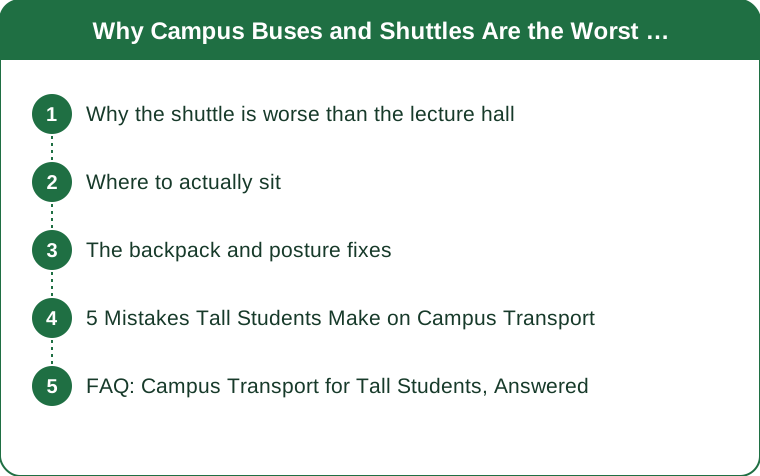
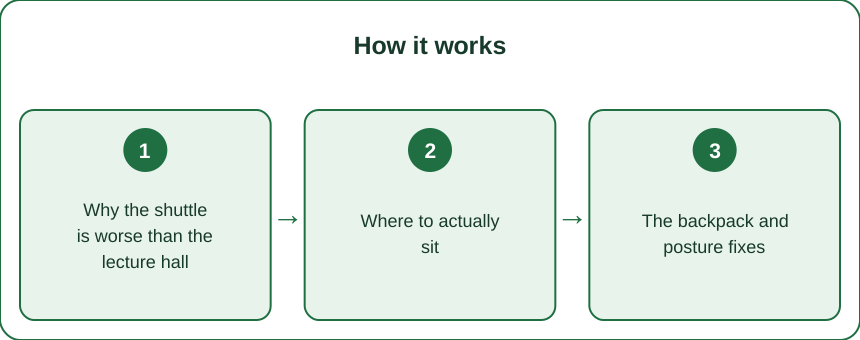
Why the shuttle is worse than the lecture hall
Seat pitch on a shuttle bus is typically far tighter than a lecture hall row, and unlike a lecture theatre there is no aisle to extend into and no chance of an empty seat beside you at peak times.
The repetition is what makes it costly. A lecture happens two or three times a week; a commute happens ten times a week, and sustained hip flexion with knees jammed high is a genuinely poor position to spend an hour a day in.
Knees higher than hips tilts the pelvis backwards and rounds the lower back. Held repeatedly, that is the position most associated with the low back ache tall students report by mid-semester.
You cannot adjust a bus seat. In a lecture hall you can slide forward, cross the aisle, or move rows. On a full shuttle you take what is left, which is why arrival timing matters more than anything else.
Backpacks make it worse. Wearing a full backpack while seated pushes you forward off the seat back, so you sit on the front edge with no support at all.
And the standing option gets dismissed too quickly. For a route under about ten minutes, standing is frequently more comfortable and better for your back than folding into a seat that does not fit.
Where to actually sit
Front row behind the driver’s partition is usually the best seat on the bus. There is often no seat in front of you, so the legroom is limited by the partition rather than by seat pitch, and that is typically several inches more.
The seats immediately behind the rear door have open floor in front of them on most shuttle layouts. This is the second-best option and it is frequently empty because people avoid standing traffic.
Avoid the wheel arch seats. They look appealing because they are raised, but the raised floor eats the legroom and forces your knees even higher.
The very back row is usually the worst. Seat pitch is tightest, the floor is often raised over the engine, and it is the hardest place to extend a leg into an aisle.
Aisle seats beat window seats by a wide margin. An aisle lets you angle one leg out, which relieves the hip position even when the pitch is unchanged. Window seats offer nothing.
Board early enough to choose. Arriving two minutes earlier at a stop is the single highest-value change available, because seat choice is entirely determined by boarding order.
And on a genuinely short route, stand. A hand on the rail, weight even, beats ten minutes of compressed hip flexion every time.

The backpack and posture fixes
Take the backpack off before sitting and put it on your lap or between your feet. Wearing it seated pushes you off the seat back and guarantees the rounded position you are trying to avoid.
On your lap is better than between your feet for tall students specifically - it does not compete with the very legroom you are short of.
When standing, wear it on the front in a crowded bus. It keeps the weight over your centre of mass, and it stops the swing that a rear-mounted heavy bag creates when you brace against braking.
Adjust the straps so the bag sits high on your back. A bag hanging low pulls the shoulders back and down, and long torsos amplify that leverage. High and tight is the rule.
Use both straps, always. One-strap carrying is worse for tall students than for anyone else because the longer torso means a longer lever arm for the asymmetric load.
And stand up before your stop rather than after. Fifteen seconds of standing before the doors open breaks the compressed position and makes the walk to your next building noticeably better.
5 Mistakes Tall Students Make on Campus Transport
1. Taking the first available seat. The first free seat on a shuttle is usually the worst one, because everybody else already rejected it. Ten seconds of scanning changes the whole ride.
2. Keeping the backpack on while seated. It pushes you onto the front edge of the seat with no back support at all, which is worse than the legroom problem it seems to solve.
3. Choosing the window seat for the view. A window seat removes your only real relief - the ability to angle a leg into the aisle.
4. Sitting on routes under ten minutes. Standing with a hand on a rail is genuinely better than a badly-fitting seat for a short hop, and most people never consider it.
5. Not adjusting the schedule. If two shuttle times exist and one is always packed, the less popular one gives you seat choice - which is worth more than the ten minutes it costs.
The underlying pattern is treating the commute as fixed. It is not. Boarding time, seat position, bag placement, and route choice are all yours, and together they change roughly an hour a day.
FAQ: Campus Transport for Tall Students, Answered
What is the best seat on a campus shuttle if I am tall?
The front row behind the driver’s partition, where there is usually no seat directly in front of you. The seats immediately behind the rear door are the next best, because the floor there is often open.
Which seats should I avoid?
Wheel arch seats and the back row. Both have raised floors that reduce legroom further, and the back row typically has the tightest pitch on the vehicle.
Is standing actually better than sitting?
On short routes, often yes. Ten minutes of compressed hip flexion with knees above hips is worse for most tall people than standing with a hand on a rail.
Where should my backpack go when I sit down?
On your lap. Wearing it seated pushes you off the seat back onto the front edge, and putting it between your feet competes with the legroom you already lack.
Why does my lower back ache by mid-semester?
Repeated time with knees higher than hips tilts the pelvis backwards and rounds the lumbar spine. An hour a day of that adds up across a term. Persistent back pain deserves a proper assessment - this is general information, not medical advice.
Does aisle or window matter?
Aisle, clearly. It lets you angle one leg out, which relieves hip position even when seat pitch does not change. A window seat offers no such option.
What is the single most effective change?
Boarding two minutes earlier. Seat choice is entirely determined by boarding order, and the difference between the best and worst seat on a shuttle is substantial.
TL;DR:
- Shuttles are worse than lecture halls because the pitch is fixed, nothing adjusts, and it repeats ten times a week.
- Best seats: front row behind the partition, then immediately behind the rear door. Worst: wheel arch and back row - raised floors eat legroom.
- Aisle over window, always. Angling a leg out is your only real relief.
- Backpack on your lap when seated. Wearing it pushes you onto the front edge with no back support.
- Stand on routes under ten minutes. A rail beats a seat that does not fit.
- Board two minutes earlier - seat choice is decided entirely by boarding order.
- Stand up before your stop, not after, to break the compressed position.
An hour a day across a semester is roughly 60 hours in a seat that does not fit. Persistent back pain deserves proper assessment - this is general information, not medical advice.
Keep Reading
This article is for general informational and styling purposes only. Fit, sizing, and product availability may vary.