Why Dorm Desk Chairs Wreck Tall Students Backs by Midterms
Quick Answer: Institutional dorm chairs and desks are built around a seated eye height and leg length near the 50th percentile. If you are over about 5’10”, the seat is too low and the desk too shallow, forcing forward head posture and hip flexion past 90 degrees. Raising the laptop and the seat — in that order — fixes most of it for under $60.
Week one, the desk was fine. By week seven, you have a permanent knot between your shoulder blades and your lower back aches when you stand up from a study session.
Nothing about your body changed. You just spent forty hours in furniture designed for someone six inches shorter.

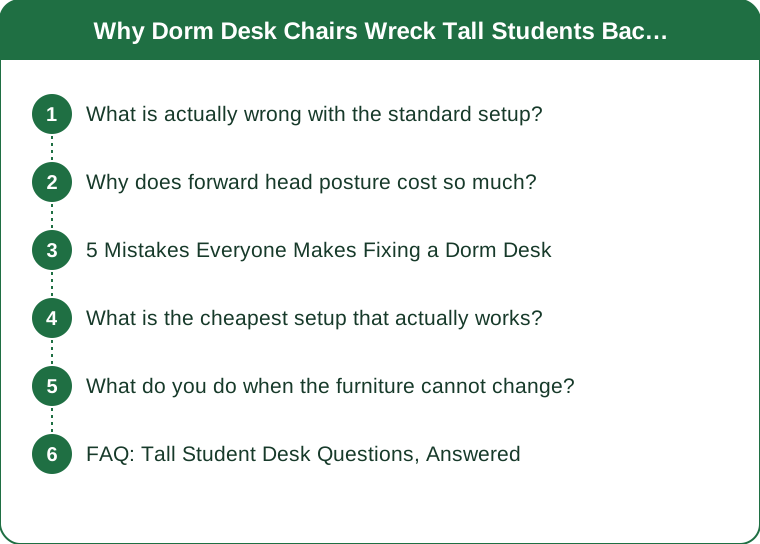
What is actually wrong with the standard setup?
Institutional furniture clusters tightly around a few standard dimensions. Desk height is almost always 29 to 30 inches. Chair seat height is typically 17 to 18 inches, often fixed. Monitor or laptop sits directly on the desk.
For someone around 5’6”, that geometry roughly works: feet flat, thighs parallel to the floor, screen a bit low but manageable.
At 6’0” and above, three things break at once. Your knees sit higher than your hips, which tilts the pelvis backward and flattens the lumbar curve. Your elbows land well below desk height, so your shoulders shrug up to reach the keyboard. And the screen — already low for everyone — is now 10 to 14 inches below your natural eye line, so your neck flexes forward for hours.
Each of these alone is tolerable. Together, for six weeks, they are how you get to midterms with a back that hurts.
Why does forward head posture cost so much?
The head weighs roughly 10 to 12 pounds in neutral position. Tilting it forward multiplies the load on the neck and upper back muscles — at a 45 degree tilt, the effective load has been estimated at close to 50 pounds.
Those muscles are not designed for sustained isometric holds. They are designed for brief adjustments. Ask them to hold a heavy load for three hours and they respond with exactly what you are feeling: a persistent knot along the upper trapezius and levator scapulae, and a dull ache at the base of the skull.
The reason it appears around midterms rather than week two is dose. Study hours climb sharply, sleep drops, and daily walking around campus — which was quietly undoing some of the damage — falls off.
This is also why stretching alone does not fix it. You can stretch a muscle that is being loaded eight hours a day and it will simply be tight again by dinner.
5 Mistakes Everyone Makes Fixing a Dorm Desk
1. Buying a lumbar cushion first. It is the most-purchased fix and one of the least effective when the real problem is seat height and screen height. Fix the geometry, then decide if you still need support.
2. Raising the chair without raising the desk. If your chair adjusts, going higher fixes your hips but drops your elbows further below the desk. You need both, or you need the laptop raised instead.
3. Using the bed as the alternative. Studying in bed puts the neck in worse flexion than any desk. It feels better for 20 minutes and worse for the rest of the day.
4. Ignoring foot support. If you raise your seat, your feet may no longer sit flat. A textbook stack or a $15 footrest keeps the hip angle you just bought.
5. Treating it as a posture problem. Posture is an output, not an input. Nobody maintains good posture in bad geometry through willpower — you change the furniture, and posture follows.

What is the cheapest setup that actually works?
Order matters. Fix the largest angle errors first, and most of the cost disappears.
1. Raise the screen — $0 to $25. Your laptop screen should have its top edge at or just below eye level. For most tall students that means 6 to 10 inches of lift. A stack of textbooks works perfectly; a folding laptop stand is tidier.
2. Add an external keyboard — $20 to $35. As soon as the screen goes up, the keyboard has to come down, or your arms are reaching upward. This is non-negotiable once the screen is raised, and it is the piece students most often skip.
3. Raise the seat — $0 to $30. If the chair adjusts, raise it until your thighs slope slightly downward from hip to knee. If it does not adjust, a firm 2-inch foam cushion accomplishes most of it.
4. Support the feet — $0 to $15. Feet flat, ankles under knees. A ream of paper or a small crate does the job.
5. Raise the desk last — $20 to $40. If your elbows still sit below the desk surface with everything else right, furniture risers under the desk legs add 2 to 4 inches. Check your housing rules first; most permit non-permanent risers.
Total for a genuinely correct setup: $40 to $90, and the first two steps alone resolve most symptoms.
What do you do when the furniture cannot change?
Library carrels, lecture halls, and lab benches are fixed. The lever there is time, not geometry.
Use a 40-minute ceiling. In a bad seat, stand and move every 40 minutes without exception. Two minutes of walking resets the muscle loading far more effectively than shifting position in the chair.
Carry a portable stand. A folding aluminum laptop stand weighs about half a pound and turns any library table into a workable setup. Paired with a compact keyboard, it is the single highest-value thing a tall student can carry.
Alternate locations by task. Reading can happen standing at a high counter or walking. Save the seated desk for work that genuinely requires typing.
Do two counter-movements daily. Doorway chest stretch for 30 seconds each side and chin tucks, 10 reps, twice a day. These will not overcome bad geometry, but they meaningfully help when combined with fixing it.
This is general information, not medical advice. Back or neck pain that persists beyond a few weeks, or that radiates into an arm or leg, should be evaluated by a healthcare professional — most campuses include this in student health services.
FAQ: Tall Student Desk Questions, Answered
Can I request different furniture from residential life?
Often yes, and more easily than students assume. Many housing offices have taller desk chairs or bed risers available on request, sometimes without documentation. Ask early in the term — supply is limited.
Is a standing desk converter worth it in a dorm?
A cheap one can be, but only if you also solve the screen height, which many converters do not for tall users. Alternating standing and sitting is genuinely better than either alone; just measure before buying.
Why does it hurt more during exam weeks specifically?
Sitting hours spike, sleep drops, walking between classes falls off, and stress raises baseline muscle tension. The furniture was always wrong — exam weeks just increase the dose enough to make it symptomatic.
TL;DR:
- Dorm furniture is built around a 50th-percentile body; over about 5’10” the seat is too low and the screen far too low.
- Forward head posture can multiply effective neck load several times over, and it accumulates with study hours.
- Fix in order: raise the screen, add an external keyboard, raise the seat, support the feet, then raise the desk.
- In fixed seating, manage time instead — stand every 40 minutes and carry a folding stand.
The knot between your shoulder blades is not a sign you need better discipline about sitting up straight. It is a measurement problem, and it costs less than a textbook to solve. Do it before midterms rather than after.
Keep Reading
This article is for general informational and styling purposes only. Fit, sizing, and product availability may vary.