Why Lecture Hall Seating Wrecks Tall Students More Than Studying Does
Quick Answer: Fixed lecture seating is designed around a seat height of roughly 43-45cm and a fixed tablet-arm distance, both set for average proportions. If you are tall, your knees sit above your hips and the writing surface forces a forward head position you hold for hours. The fix is positional, not medical: pick aisle or front-row seats with legroom, raise your laptop, and interrupt the position every 20 minutes.
Three hours a day.
Five days a week.
Fourteen weeks a semester. That is not a posture habit, that is a repetitive loading exposure.

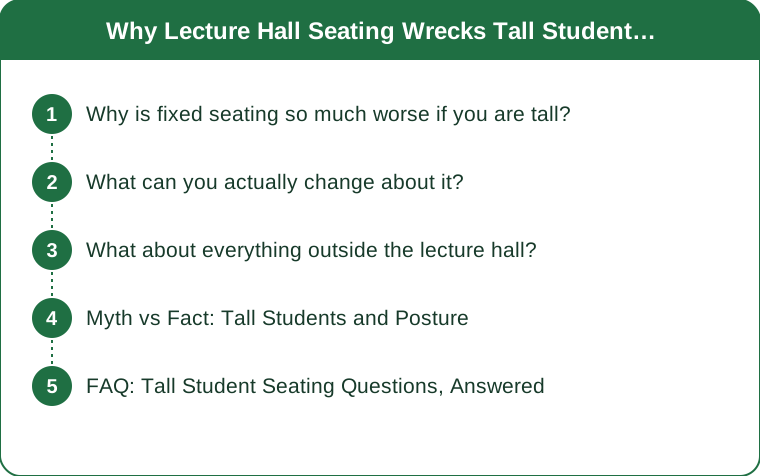
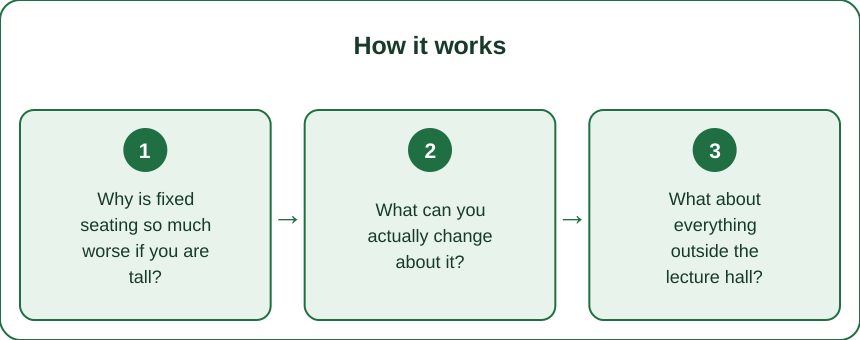
Why is fixed seating so much worse if you are tall?
Six specific mismatches, and they compound each other.
Seat height is set for average legs. Standard fixed seating puts the seat pan around 43-45cm from the floor. If your lower leg is longer than that, your knees rise above your hip line, which rotates the pelvis backwards and rounds the lower back automatically. You cannot sit upright from that position without conscious effort.
Seat depth is too short. A shorter seat pan leaves your thighs unsupported at the front, so your weight concentrates on a smaller area and you slide forward to compensate — which rounds the spine further.
Tablet arms are fixed at one height and distance. They are positioned for an average torso. A longer torso and longer arms means either hunching down to the surface or writing with the arms unsupported, and both are held for the whole lecture.
Backrests hit the wrong part of your spine. Lumbar support built for average torso length lands in the mid-back on a taller person, providing no lumbar support at all and pushing the upper back forward.
Row spacing forces the knees sideways. With insufficient legroom, you angle your legs into the aisle or splay them, which twists the pelvis and loads one side of the lower back for the whole session.
And it accumulates. A single lecture is not the problem. Fifteen hours a week for fourteen weeks, in a position with no adjustment available, is a genuine cumulative load — and it shows up as neck and mid-back ache that feels unrelated to sitting.
What can you actually change about it?
Six practical fixes, ranked by how much difference they make.
Choose your seat strategically and arrive early enough to get it. Aisle seats give you somewhere to put a leg. Front rows in tiered halls usually have more legroom. Back rows often have a wall or rail to lean against. This one decision outweighs everything else on this list.
Raise your writing surface rather than lowering your head. A laptop on a stand, or on a stack of two textbooks, brings the screen up 10-15cm and removes most of the forward head position. Then use a separate keyboard, or accept a compromise and just raise it for reading-heavy sessions.
Sit back, not forward. With a short seat pan, the instinct is to perch on the front edge. Sitting fully back with a rolled jumper or small cushion behind your lower back restores the lumbar support the seat does not provide.
Break the position every 20 minutes. Not a full stretch routine — just a change. Shift weight, extend a leg, sit tall for thirty seconds, roll the shoulders back. Position variety beats perfect posture, and it is realistic in a lecture.
Use your bag, not the tablet arm. A bag on your lap under a notebook raises the writing surface several centimetres and is completely unremarkable in a lecture hall.
Strengthen what the position weakens. Face pulls, band pull-aparts and prone Y raises, 3 sets of 12, three times a week target the mid-back and rear shoulder muscles that hours of forward posture lengthen and weaken. Ten minutes, and it does more than stretching alone.

What about everything outside the lecture hall?
Six factors that decide whether the seating exposure becomes an actual problem.
Your desk setup matters more than your lecture seat, because you spend more hours there. Monitor top at eye level, elbows around 90 degrees, feet flat. Tall students almost always need to raise the monitor and often need a taller chair than a standard dorm one provides.
Bed studying is the real culprit for many people. Hours on a laptop in bed puts the neck in extreme flexion. If it is unavoidable, prop the laptop on a stack of books and sit against the headboard rather than lying.
Backpack fit is a tall-specific problem. A pack whose shoulder straps are too short sits high and pulls the shoulders back and up; one that hangs too low pulls you into forward lean. Look for longer torso length packs rather than just bigger volume.
Walking between buildings is your recovery. Campus walking is genuinely useful, and it is the reason many students get away with poor seating. Cutting it out in bad weather is often when symptoms appear.
Sleep position and mattress length. A standard dorm bed is frequently too short for a tall student, and sleeping curled to fit has consequences. A mattress topper does not fix length — an extra-long frame or diagonal sleeping does, awkwardly.
Seasonal note: symptoms usually appear four to six weeks into a semester, which puts the peak in late September and October for autumn terms. If you are starting a term now, fixing your seat choice and desk height in the first fortnight is far easier than trying to reverse an ache in November. And clothing that binds at the waist when you sit — anything that fits standing but digs in seated — quietly encourages you to sit forward on the edge. Tall-cut waistbands and longer-rise trousers are a genuine ergonomic factor here, not just a comfort one.
Myth vs Fact: Tall Students and Posture
Myth: back pain from sitting means you have bad posture. Fact: the strongest driver is duration in one position, not the position itself. Moving every twenty minutes beats holding a perfect position for two hours.
Myth: you should sit up straight at all times. Fact: a rigidly held upright position is fatiguing and unsustainable. Varying between several reasonable positions is both more comfortable and better supported by the evidence.
Myth: tall people are naturally more prone to back problems. Fact: taller people are more likely to be sitting in poorly fitted furniture, which is an environment problem rather than a body problem. Fit the environment and the difference largely disappears.
Myth: a lumbar cushion fixes everything. Fact: it helps if it sits at the right height, which for a longer torso is often higher than the cushion is designed for. A rolled jumper you can position yourself is frequently better than a moulded product.
Myth: stretching is the answer to mid-back ache. Fact: stretching offers temporary relief; strengthening the mid-back and rear shoulders is what changes the pattern. Do both, but do not skip the strength half.
Myth: you need an expensive ergonomic chair. Fact: seat height and monitor height do most of the work, and both can be solved with books and a stand for almost nothing. This is general information, not medical advice — persistent pain, numbness or tingling down an arm or leg needs a professional assessment.
FAQ: Tall Student Seating Questions, Answered
Why does my back hurt more during term than in the holidays?
Fifteen hours a week in fixed seating sized for average proportions is a cumulative load your body does not get in the holidays.
What is the best seat in a lecture hall if I am tall?
Aisle seats for legroom, or front rows in tiered halls. Getting there early to claim one is worth more than any cushion.
How high should my laptop be?
High enough that you look at the screen without dropping your chin — usually 10-15cm above a flat desk, which is about two textbooks.
How often should I move?
Every 20 minutes, even briefly. Position variety matters more than holding a perfect position.
What exercises help most?
Face pulls, band pull-aparts and prone Y raises, 3 sets of 12, three times a week for the mid-back and rear shoulders.
Is studying in bed really that bad?
It is the worst common position for neck flexion. If you must, sit against the headboard with the laptop raised on books.
When should I see someone about it?
If pain persists beyond a few weeks despite changing your setup, or if you get numbness, tingling or weakness down an arm or leg, get it assessed.
TL;DR:
- Fixed lecture seating is built around a 43-45cm seat height and average torso length — neither fits a tall frame.
- The damage is cumulative duration, not one bad lecture: fifteen hours a week for fourteen weeks.
- Seat choice is your biggest lever — aisle or front row, claimed by arriving early.
- Raise the writing surface, sit fully back with lumbar support you improvise, and move every 20 minutes.
- Strengthen the mid-back with face pulls and band pull-aparts, 3x12, three times a week.
Before your next lecture, decide which seat you are aiming for and leave five minutes earlier. That is the whole intervention.
Keep Reading
This article is for general informational and styling purposes only. Fit, sizing, and product availability may vary.