Why Move-In Day Is the Only Chance to Fix a Dorm That Does Not Fit You
Quick Answer: Dorm furniture is standardised around an average that most tall students sit well outside, and the two things that matter most — bed height and desk-chair-monitor geometry — are usually adjustable only while the room is empty. Once the bed is made, the shelves are loaded, and the roommate has settled, nobody moves anything again. Spending 90 focused minutes on move-in day setting height, orientation, and reach saves a semester of back and neck strain.
Do the measuring before you unpack the clothes.

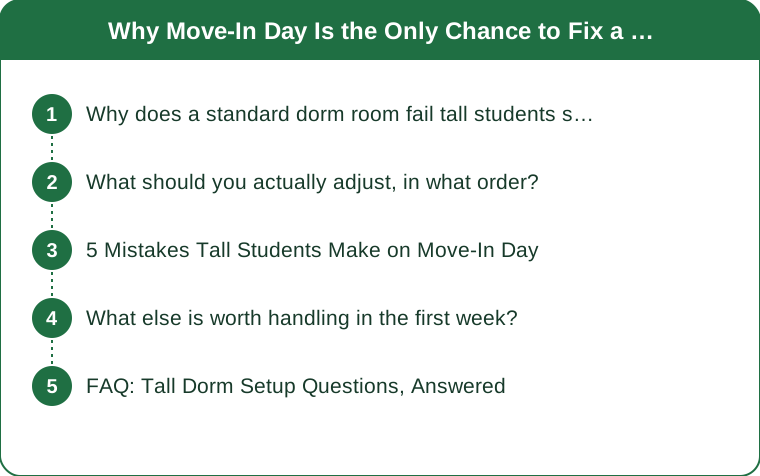
Why does a standard dorm room fail tall students specifically?
Because every dimension in it was chosen for a median body, and the errors compound rather than cancelling out.
Desk height is fixed and low. Most dorm desks are built to a standard around 73 to 76cm, which suits someone of average height in a chair set to average height. A taller student either sits with knees jammed underneath or raises the chair and works with shoulders shrugged.
The chair is the usual failure point. Dorm chairs are frequently fixed-height wooden or plastic, with no lumbar adjustment and a seat pan too short to support a long femur. A seat pan that ends well before the back of your knee means your thigh is unsupported, which drives you forward out of the backrest within twenty minutes.
Monitor and laptop height is far below eye level, because a laptop on a low desk puts the screen roughly 30cm below where a tall person’s eyes sit. Every centimetre of that gap is neck flexion, held for hours.
Bed height determines everything about the room’s storage, since under-bed space is the largest storage volume you have, and it also determines whether you hit your head on a bunk or lofted frame.
Shower heads, mirrors, and closet rails are all set to standard heights, and none of them are adjustable at all.
The compounding effect matters. A low desk, a short chair, and a low screen each contribute a small amount of forward head posture, and together they produce the neck and upper back pain that shows up reliably around midterms.
What should you actually adjust, in what order?
Bed first, because it constrains everything, then the work surface, then storage.
Step 1: Set the bed height before anything else. Most dorm beds adjust by pin or bracket, and it takes two people and ten minutes with an empty frame. Decide between two goals: maximum under-bed storage, or comfortable sitting and getting in and out.
A useful test: sit on the edge with feet flat. Your knees should be at roughly the same height as your hips or slightly lower. Too high and you are climbing in; too low and standing up from it strains the back, particularly at the end of a long day.
Lofting is worth considering if headroom allows, because it converts the single largest area of the room into usable storage and desk space. Check the ceiling clearance while sitting up in the bed, not while standing next to it.
Step 2: Fix the seated work position. In order of impact:
Raise the screen. A laptop stand plus an external keyboard is the cheapest and most effective ergonomic change available, and it costs less than a textbook. The top of the screen should sit at roughly eye level.
Deal with the chair. If it is not adjustable, a firm seat cushion raises you relative to a fixed desk, and a rolled towel or small cushion at the lumbar curve does more than most ergonomic products.
If raising the chair leaves your knees hitting the desk, the desk is the problem, and desk risers under the legs are a legitimate solution that most students never consider.
Step 3: Reorganise storage by reach. Put daily items at your natural hand height, not at the height the previous occupant used. Tall students have an advantage here — high shelves are usable — so put rarely-used items low and daily items high, which is the opposite of the default.

5 Mistakes Tall Students Make on Move-In Day
1. Unpacking before adjusting. Once the bed is made and the shelves are full, nobody moves the frame. Adjust an empty room, always.
2. Not measuring the desk. Thirty seconds with a tape measure tells you whether you need a riser, and it is far easier to buy one in the first week than in October.
3. Accepting the chair. The chair is the piece most likely to be wrong and the piece students most readily accept as fixed. A cushion, a lumbar roll, or a different chair from a common area transforms it.
4. Choosing the bed position by aesthetics. Where the bed sits determines whether you can sit up without hitting a shelf, whether the desk gets the window light, and whether you can get in and out without turning sideways. Function first, in a room this small.
5. Not talking to the roommate about it on day one. Furniture arrangement is a shared decision that becomes very hard to reopen in week six. The conversation is easy while both families are still carrying boxes and awkward afterwards.
What else is worth handling in the first week?
The things that are easy in August and impossible in October.
Find out what maintenance will and will not adjust. Many schools will change bed height, replace a broken chair, or provide an alternative desk if asked, and almost none will do it in November when they are busy. Ask in the first week.
Sort the shower situation early. A fixed low shower head is one of the most consistent complaints from tall students, and a handheld attachment or an extension arm is inexpensive and often permitted. Check the housing rules rather than assuming.
Buy the bedding that actually fits now. Extra-long twin is the standard in most dorms and it still leaves many tall students short. Sheets that pull off the corners in the night are an all-year annoyance, and stock disappears fast in late August.
Set up the study space you will use in winter. Right now the campus is warm and everyone works outside. The desk you ignore in September is the desk you live at in January, and getting it right while you have time and energy pays off later.
Sort the walking kit. Campus walking in late summer heat, then rain, then cold, over a semester. Shoes that fit properly matter more when you cover more ground per stride, and tall students generally walk further per day than they expect on a large campus.
Set a posture check. The pain that shows up at midterms builds invisibly from week one. A two minute break every 45 minutes, standing and moving, is the single most effective preventive measure and the easiest to establish while the semester is still calm.
If you are already dealing with persistent neck, back, or shoulder pain, campus health services are worth using early rather than at the point it disrupts exams. This is general guidance, not medical advice.
FAQ: Tall Dorm Setup Questions, Answered
Can I actually change the bed height myself?
Usually yes — most dorm frames adjust by pin or bracket, and it takes two people and a few minutes on an empty frame. Check your housing rules first, and ask maintenance if the frame does not obviously adjust.
What is the single best purchase for a tall student’s desk?
A laptop stand with a separate keyboard. It moves the screen to eye level and lets your arms sit at a comfortable height independently, which fixes the two biggest problems at once.
Should I loft my bed?
If ceiling height allows you to sit up comfortably in the bed, it is usually the best use of the room’s volume. Measure while sitting on the mattress, not standing beside the frame.
What if my chair cannot be adjusted?
A firm cushion changes your height relative to the desk, and a lumbar roll changes the support. If the desk then becomes too low, risers under the desk legs solve it from the other direction.
TL;DR:
- Dorm furniture is built around an average, and the errors in desk, chair, and screen height stack into real strain by midterms.
- Adjust the bed while the room is empty; it constrains storage, headroom, and how you get in and out.
- Raise the screen to eye level with a stand and separate keyboard — the highest-value change available.
- Ask maintenance, buy the bedding, and fix the shower head in the first week, because none of it happens later.
Measure your desk height before you open a single box. The whole semester turns on that number.
Keep Reading
This article is for general informational and styling purposes only. Fit, sizing, and product availability may vary.